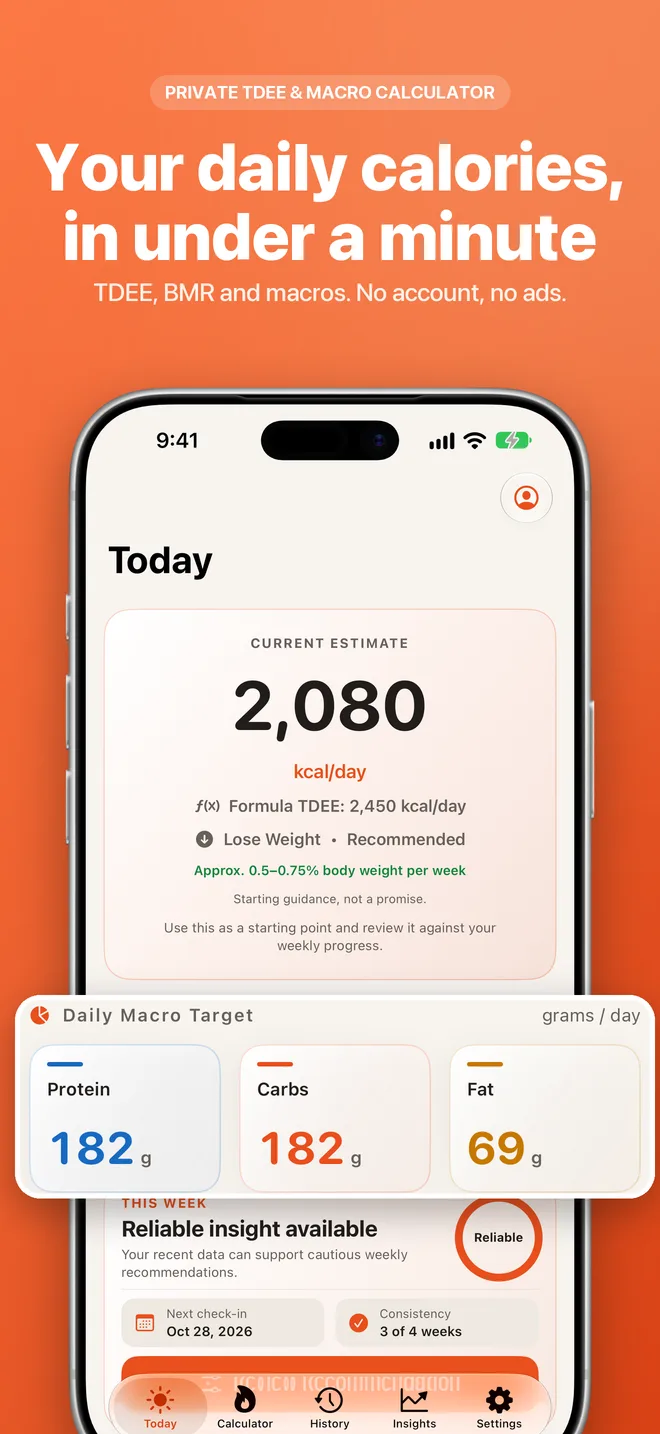
Your TDEE is your BMR multiplied by an activity factor between 1.2 and 1.9. For a 35-year-old woman, 5′5″ (165 cm), 165 lb (75 kg), moderately active, that's about 2,239 kcal/day (BMR 1,444 × 1.55). Eat around that to maintain your weight, roughly 10–20% less to lose fat, or 5–15% more to build muscle.
What is TDEE?
Total daily energy expenditure (TDEE) is the number of calories your body burns in a full day. It's the sum of four parts, and only the first is fixed:
- Basal metabolic rate (BMR), 60–70%: the energy to stay alive at rest. Calculate your BMR.
- Non-exercise activity (NEAT): walking, standing, fidgeting and chores. It is the most variable part of TDEE and can differ by hundreds of calories a day between people of similar size (Levine, 2002).
- Exercise: usually a smaller share than people expect, typically 5–10% of TDEE.
- Thermic effect of food (TEF): about 10% of what you eat goes into digesting it, and more for protein (Westerterp, 2004).
How this TDEE calculator works
The calculator runs two steps, the same way the TDEECalc app does:
- Estimate BMR with the Mifflin–St Jeor equation, which a systematic review found to be the most accurate everyday equation for healthy adults (Mifflin et al., 1990; Frankenfield et al., 2005). If you add body fat, you can switch to Katch–McArdle or Cunningham.
- Multiply by an activity factor to scale resting energy up to your whole day.
From TDEE it sets a calorie target for your goal (−10/−15/−20% to lose, +5/+10/+15% to gain) and splits it into protein, carbs and fat. See the full methodology.
TDEE activity multipliers
| Activity level | What it looks like | Multiplier | Example TDEE |
|---|---|---|---|
| Sedentary | Desk job, little or no exercise | ×1.2 | 1,733 |
| Light | Light exercise 1–3 days/week | ×1.375 | 1,986 |
| Moderate | Moderate exercise 3–5 days/week | ×1.55 | 2,239 |
| Active | Hard exercise 6–7 days/week | ×1.725 | 2,491 |
| Athlete | Twice daily training or physical job | ×1.9 | 2,744 |
Step counts help too. Researchers classify under 5,000 steps a day as sedentary, 5,000–7,499 as low active, 7,500–9,999 as somewhat active and 10,000 or more as active (Tudor-Locke et al., 2011). Those bands line up roughly with the Sedentary, Light, Moderate and Active levels here. Our steps to calories calculator converts your steps directly.
TDEE for weight loss, maintenance and muscle gain
| Goal | Adjustment | Example target | Expected pace |
|---|---|---|---|
| Lose (faster) | −20% | 1,791 | ≈ 0.9 lb/week at first |
| Lose (moderate) | −15% | 1,903 | ≈ 0.7 lb/week at first |
| Lose (gentle) | −10% | 2,015 | ≈ 0.4 lb/week at first |
| Maintain | 0% | 2,239 | Stable weight |
| Gain (lean bulk) | +5–10% | 2,351–2,463 | ≈ 0.25–0.5% of body weight/month |
Weight loss slows over time because a lighter body burns less. The old "3,500 calories = 1 pound" rule ignores this and overpredicts long-term loss (Hall et al., 2011). Our weight loss calculator recalculates TDEE week by week instead.